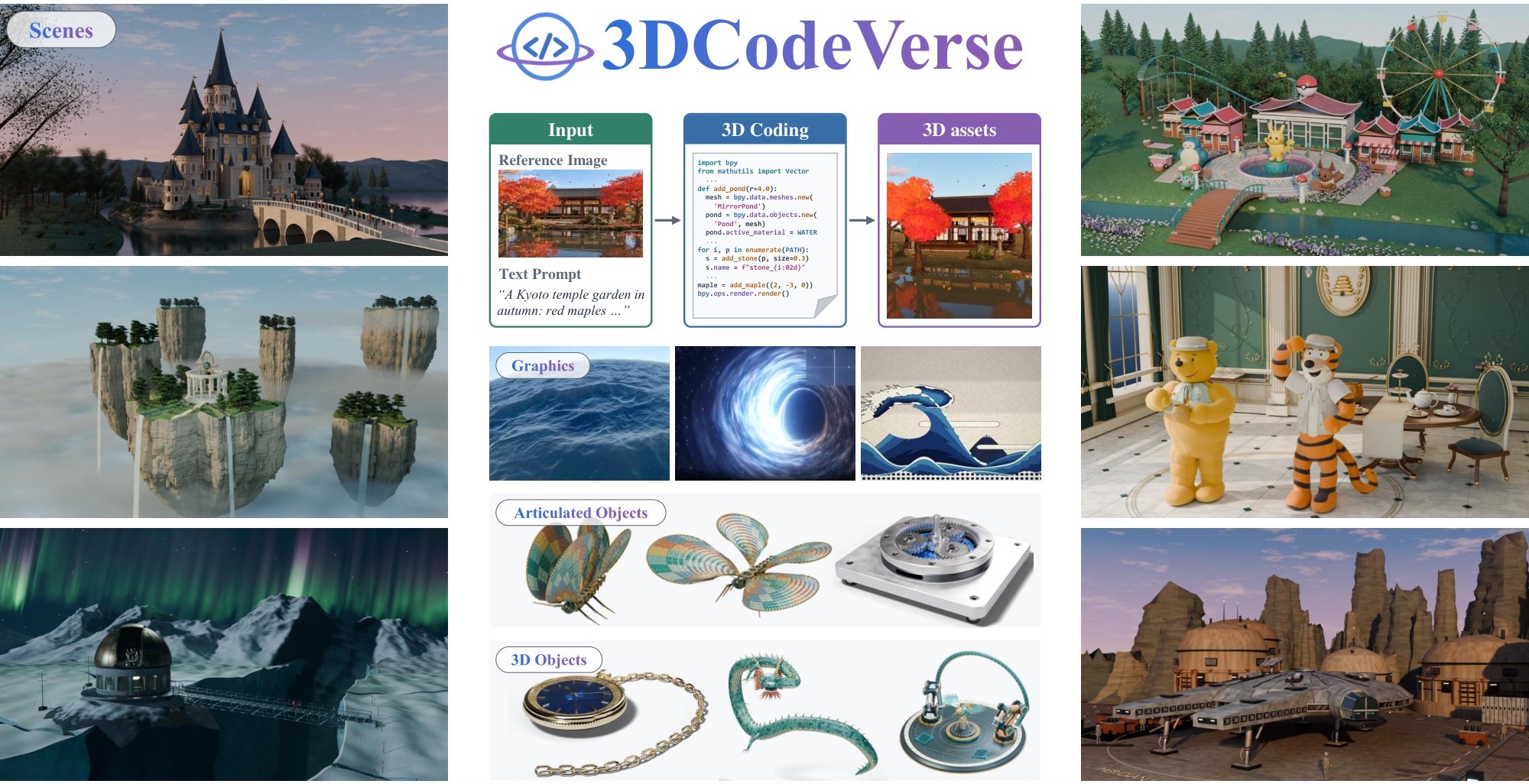
Our aim is an AI agent that can build 3D worlds and check its own work. 3DCodeVerse is how we get there. The agent writes each world as a program, in Blender Python, Three.js, CadQuery, OpenSCAD, GLSL, OpenGL or URDF. Run the program and you get the world. Keep the program and you can measure it, fix it, and change it one line at a time.
It is a joint project with researchers from eight universities and labs, led at USC. Everyone is listed at the end.
From the crab film
In August we wrote about Not a Keeper, an 86-second film about a crab in which every rock, wave, claw and note is code. Because the film was code, a check could find what nobody had noticed: the splash, firing right on time, 0.9 metres above the top of the frame.
We said then that this points two ways. One is a new way to make films, where the storyboard, camera, acting and sound are all programs that can be checked. The other is physical recursive self-improvement: AI that gets better at building the physical world by learning from its own checked work, because in code every mistake becomes a number.
The crab was one world made by one agent. 3DCodeVerse tests the same idea at research scale.
A good render can still be wrong
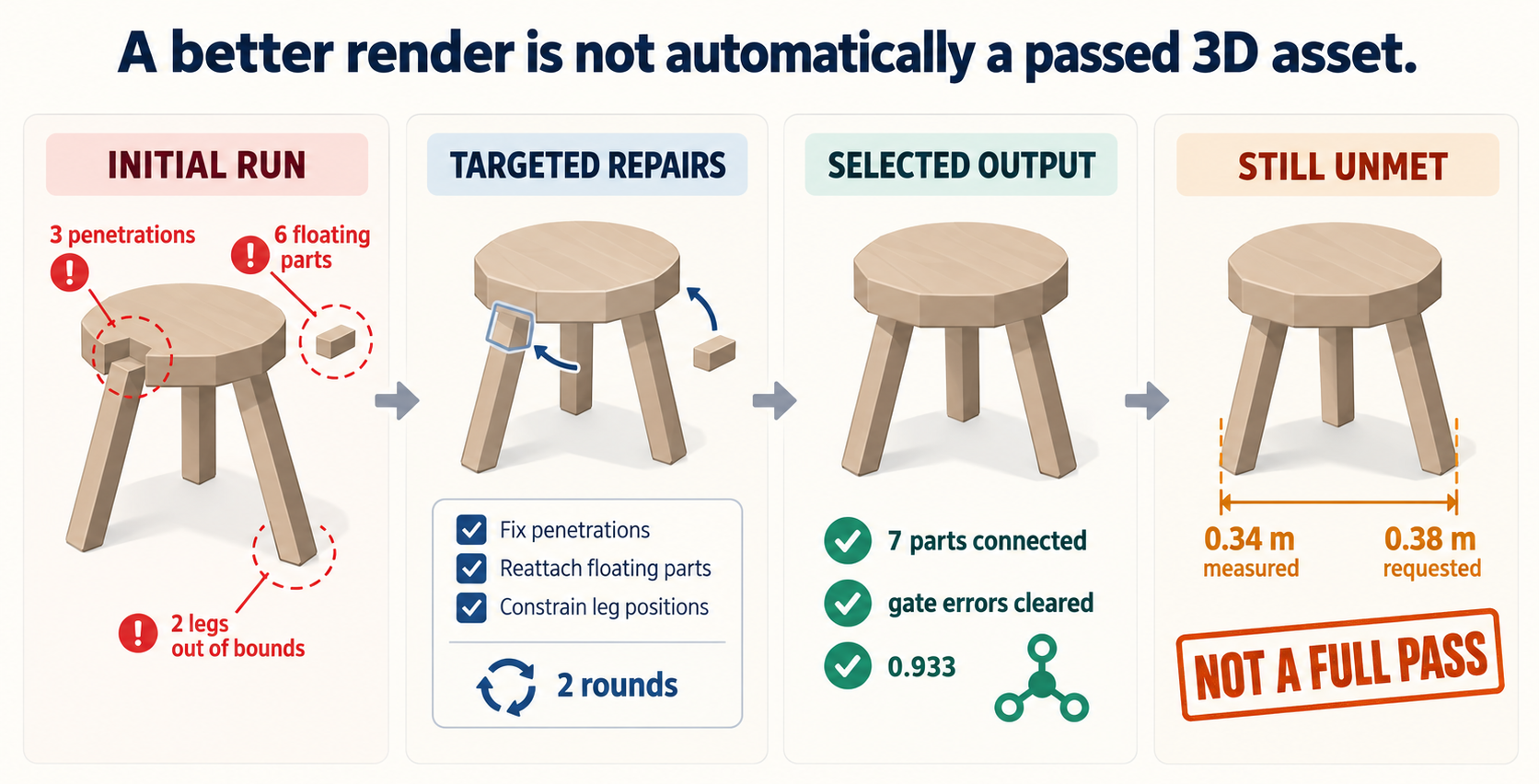
Ask the agent for a three-legged wooden stool. The first render looks like a stool. The measurements find three wedges sunk 22 mm into the seat, six parts floating loose (one of them 212 mm from anything that could hold it up), and two legs outside the space planned for them.
The agent turned each problem into a specific fix. After one round every part was connected. After two, the stool had proper joinery and a score of 0.93 out of 1. The whole run took 4 minutes and cost $0.74. One requirement was still unmet, and the agent reported it: the base was 0.34 m across against the 0.38 m asked for.
A single picture shows none of these problems. Once the stool is code, each one is a number the agent can read.
How the agent checks its own work
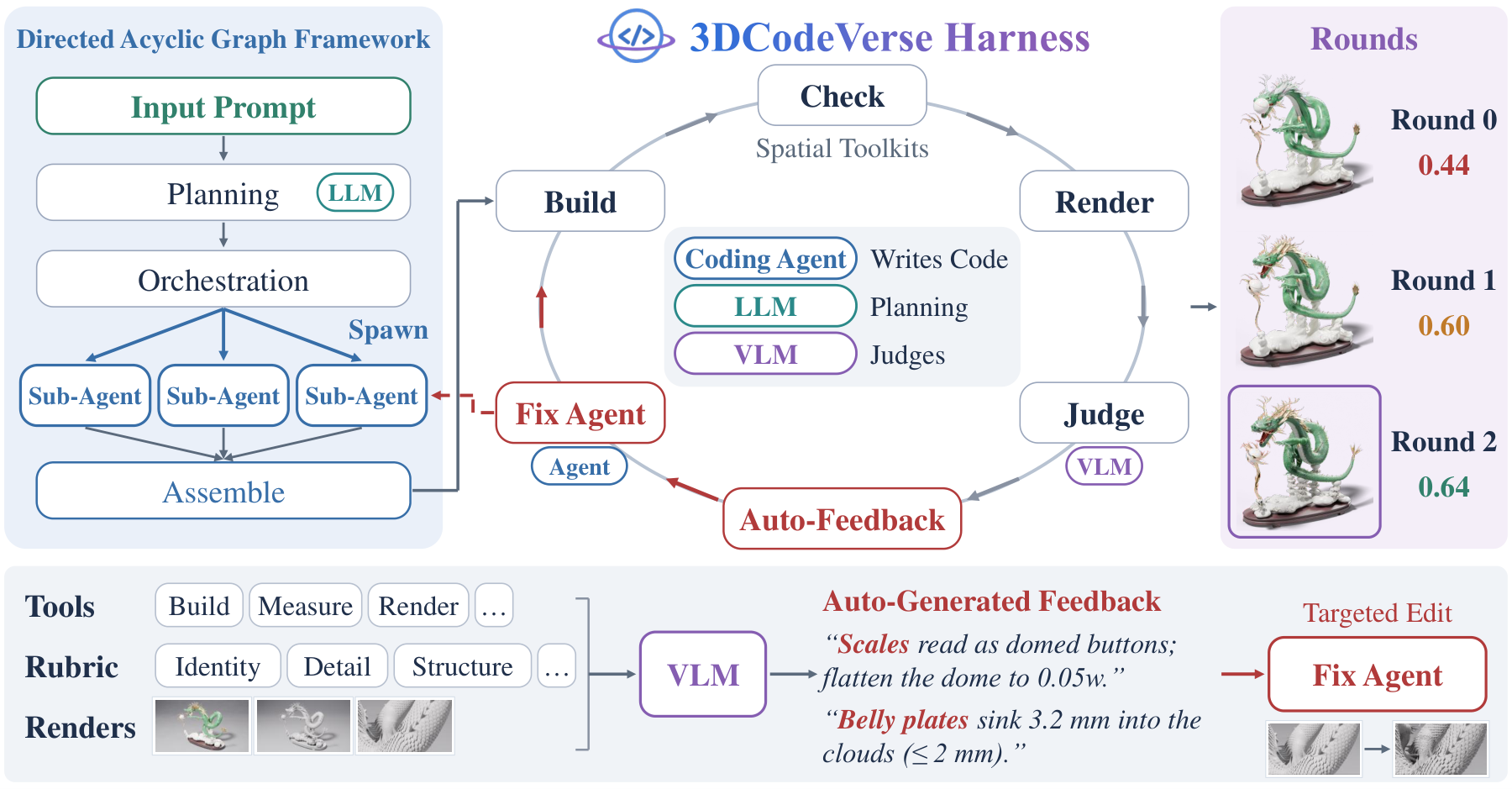
The loop behind this is the 3DCodeVerse harness, the system that runs the agent. A planner turns the prompt into parts, sizes, materials and a checklist. Several coding agents then write the parts at the same time, and each round goes through four steps:
- Build. Run the program and catch any errors.
- Measure. Check contacts, collisions, joint ranges and placement, part by part, in millimetres.
- Judge. A vision model compares labelled renders from several angles against the plan.
- Fix. Each problem becomes a precise edit, like “belly plates sink 3.2 mm into the clouds (limit 2 mm).”
When the vision model and the measurements disagree, the measurements win. Every round is saved, and the best-scoring one is the result.
Same model, better results
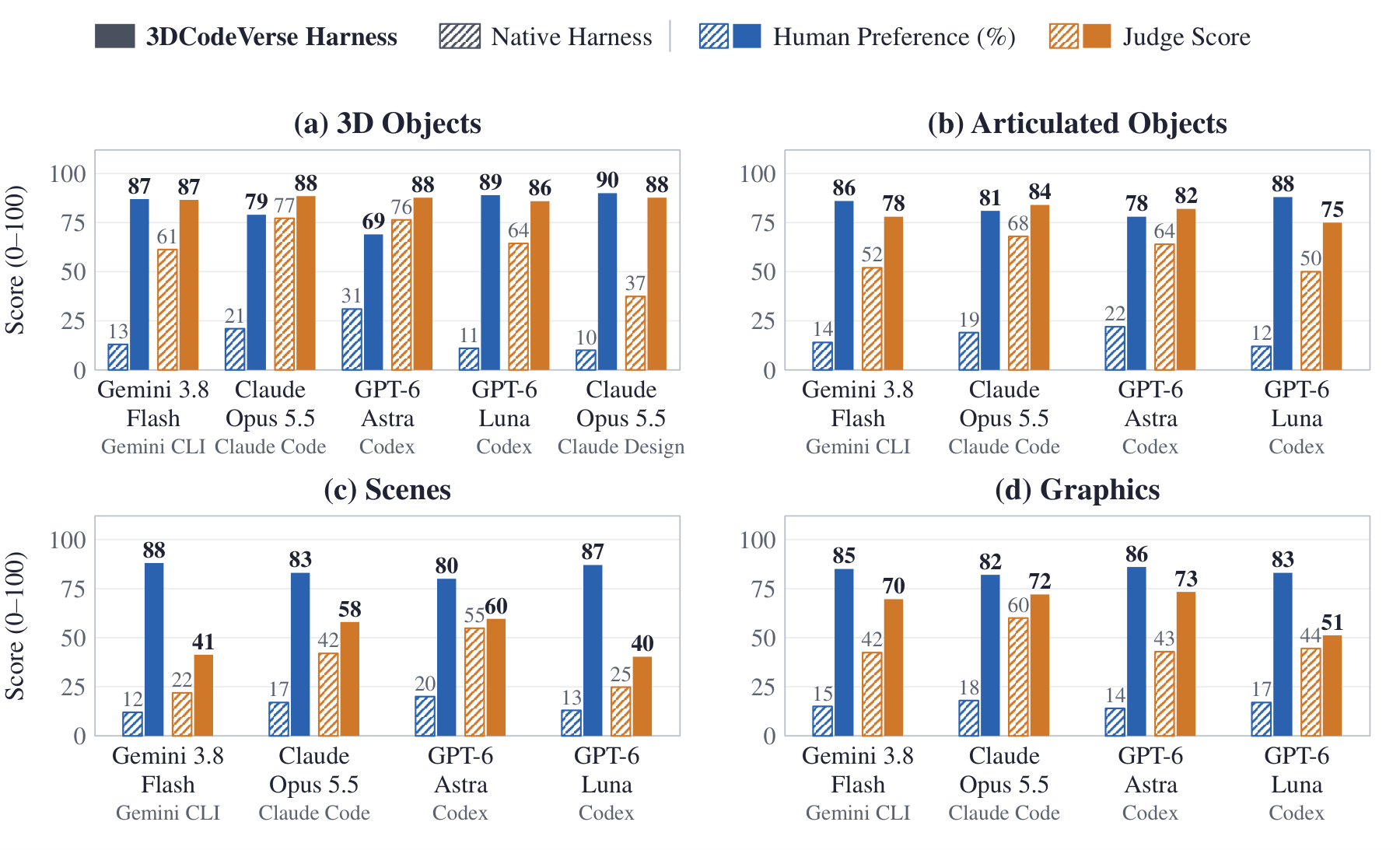
To measure what the loop adds, we ran the same AI model two ways: in its own coding tool, and inside the harness. People then compared the results side by side without knowing which was which.
For 3D objects they picked the harness version 69% to 89% of the time, across Gemini 3.8 Flash, Claude Opus 5.5, GPT-6 Astra and GPT-6 Luna. Scenes, graphics and objects with moving parts came out the same way, at 78% to 88%. With Claude Opus 5.5 behind both, the harness beat Claude Design in 90% of comparisons.
Every fix becomes training data
The harness keeps every round: what failed, what changed, and which version scored higher. That record is exactly what a model can learn from.
We combined those runs with programs from public sources into 3DCodeVerse-2M: about 270,000 runnable 3D programs in seven languages, expanded into 2 million examples that pair code with renders and descriptions.
The first thing training fixes is the most basic failure: code that does not run. A small open model, Qwen3.5-9B, went from 0% of its programs running to 85%. A larger one, Qwen3.8-27B, went from 52% to 93%. Getting the shape exactly right is harder, and still open.
Together these close the loop from the crab film. The agent checks its work, every fix is recorded, and models trained on that record write better programs for the next round.
What editable 3D is good for
Because a world is a program, changing it is precise. On the project page, one generator builds an alpine village. Change the time of day or the number of houses and only that changes: more houses means more houses, and the bridge keeps its 19 m span.
Code can also direct a video model, which is the film half of the crab story. The code fixes the layout, motion and camera, and the video model supplies the look.
The same goes for robots. Joint axes and limits are numbers in the program, so an object can be loaded into a robot simulator and varied on purpose.
The takeaway
A 3D result can look finished and still be wrong. When the world is code, the agent can find the problem, fix it, and learn from the fix. That loop made every model we tried better at 3D, and it is what we are building toward: AI that improves at the physical world by checking its own work.
Explore 3DCodeVerse
The project page, paper, code and dataset are all public.
The team
3DCodeVerse: Exploring 3D Worlds as Code
Yipeng Gao1*†, Ziyao Zeng2*, Jinfa Huang3*, Yijiang Li4*, Haolin Xiong1, Wang Qin1, Xinlei Yu1, Youheng Yao2, Jie Zhang5, Kun-Yu Lin6, Rong Liu1, Yinyuan Zhao7, Yajie Zhao1, Meiqi Guo8, Jiebo Luo3, Lei Shu8, Yunhao Ge1, Xinyu Hu9, Laurent Itti1
1University of Southern California · 2Yale University · 3University of Rochester · 4University of California, San Diego · 5Columbia University · 6Nanyang Technological University · 7University of California, Santa Cruz · 8Google DeepMind · 9Philo Labs
*Equal contribution · †Project lead